No need for Heroes
by Sandy MacGregor
 The Tunnels, the Australian story reproduced from the book No Need
For Heroes The Aussies who discovered the Viet Congs
tunnels by Sandy MacGregor as told by Jimmy Thompson.
The Tunnels, the Australian story reproduced from the book No Need
For Heroes The Aussies who discovered the Viet Congs
tunnels by Sandy MacGregor as told by Jimmy Thompson.
The deployment
of 3 Field Troop (3 Fd Tp), Royal Australian Engineers to Vietnam under the
command of Alec (Sandy) MacGregor was part of a continuum of growing overseas
engagements by the Engineers. In 1965 sappers were on operations in Malaysia
and Vietnam and remained engaged in major construction program in Papua New
Guinea. The sappers of 3 Fd Tp pioneered the way Engineers would operate
throughout that futile war. They took on the Viet Cong (VC) at his most
dangerous in tunnels and with booby traps.
Image if you can,
how it feels to launch yourself headfirst down a hole in the ground
thats scarcely wide enough for your shoulders. After a couple of meters
of slipping and wriggling straight down, the narrow tunnel takes a U-turn back
towards the surface, then twists again before heading off horizontally further
than you can see with the light from the battery powered lamp attached to your
cap.
Because the tunnel has recently been full of smoke and tear gas,
you are wearing a gas mask. The eyepieces steam up and the sound of your own
breathing competes with the thump of your heart to deafen you.
You
are in the enemys domain some of your comrades have already
died. This tunnel thats almost too small to crawl along was dug for
slightly-built Vietnamese, not gangly Aussies or broad-backed Americans. Every
inch forward has to be checked for booby traps so you have a bayonet in one
hand. Every corner could conceal an enemy soldier who can retreat no further,
so you have a pistol in the other.
Theres not enough room to
turn around going forward is difficult enough. Backing out is nigh on
impossible; the enemy knows youre there. You know your miners
light makes a perfect target. You switch off the light. The silence is ominous,
though not quite complete as the pounding of your heart throbs through your
entire body. The velvet darkness is all engulfing. Then the adrenaline rush
subsides as it becomes harder to catch your breath. You become lightheaded,
then dizzy and confused as the air runs out. Reason and sense evaporate as the
darkness claims you… Thats how it felt to be a Tunnel Rat.
Operation Crimp was a turning point for 3 Fd Tp. It had a
tragic outcome that bonded the men together as never before and made them the
soldiers they needed to be.
When 3 Fd Tp joined the infantry sweep of
the area, we expected there would be some tunnels but we had no idea that there
would be virtually an underground city, let alone what it contained. It would
turn out to be the headquarters of the Viet Cong of the Cholon/Gia Dinh area of
Saigon, the nerve center from which the enemy ran their forward operations in
the countrys South East and later masterminded their final assault on
Saigon.
The Ho Bo woods are about four kilometres to the west of the
Iron Triangle, an area North-East of Saigon that was known to have an unusually
high concentration of Viet Cong troops. The Iron Triangle hadnt been
entered in any great strength for about three years and there was a strong
feeling among the top brass that the Viet Cong had not only re-infiltrated the
area after it had been heavily shelled and bombed, but had established their
southern command Headquarters there. They were right, but what they
didnt know was that finding and destroying the VC base was a lot easier
said than done. They never imagined it would be right beneath their feet.
One of the American commanders, Major-general Dupuy, named the operation
Crimp to describe how he planned to block off escape routes to
the north and south, and then squeeze the VC between them with a sweep through
the area. Brigadier General Ellis Butch Williamson was to take
his 173rd Brigade through the north of the area while the soldiers of the 1st
Royal Australian Regiment (Infantry) were to block any escape to the south. But
the day before the assault our 1 RAR Operations officer flew low over the
proposed landing zone. He didnt like what he saw, there were no leaves
on the ground from the surrounding trees. He suspected, rightly, that earth
from recent work on defenses had covered them. He raised his objections with
the allied forces senior officers, but there was fierce opposition to
changing the plans at such a late stage. It was only when Butch Williamson
backed him up that they agreed to switch to another landing zone (LZ) nearby.
That decision almost certainly saved hundreds of Australian lives.
It
was no picnic. For a start, we were under constant fire soon after the first of
the Hueys (Helicopters) started landing men and equipment in the relocated LZ.
An artillery bombardment and air strike immediately before the ground troops
went in should have had the VC on the run. Unfortunately, they were reading a
different script and went underground during the shelling and bombing, then,
when the main body of 1RAR arrived, they began popping up on all sides from
trenches, tunnels and fox holes.
However, the Viet Cong still had one
surprise up their sleeve. When the infantrymen reached their LZ, the clearing,
which had originally been earmarked as the landing zone, they set about
securing the perimeter so that it could be crossed in safety. The area was a
mixture of low scrub and dense bush with a plantation of tress next to the LZ.
It was well defended with booby traps, from trip-wired grenades to clusters of
vicious metal or bamboo spikes hidden under grass in holes in the ground. When
some of the infantrymen reached the LZ, they came under machine gun fire. They
picked the worst option they could have seeking cover in a washed out
gully beside a track. To their cost, theyd gone to ground right under
the noses of the VC a machine gun post hidden is a hollowed-out mound
of earth. They only realized their mistake when a couple of them were shot,
virtually at point blank range. In all the confusion no one knew where the
shots had come from. The area was supposed to be secure and there should not
have been any enemy troops within range. Two medics crawled in to treat the
wounded. They were both shot and killed before the Aussies, realizing the shots
were coming from the narrow slits in the mound of earth, returned fire. That
deadly mound, which looked for all the world like an anthill, became the key to
one of the greatest secrets of the Vietnam War. But all it represented to the
soldiers in the gully was a threat to their lives, so a couple of grenades made
it safe until it could be investigated.
Meanwhile, a counter attack
was anticipated, so that first night we set about consolidating our positions.
As darkness fell, we could hear the sounds of the Viet Cong below us. We
expected theyre to be tunnels and we knew the VC were in them. But had
we known the extent of the tunnel system, or what it contained, none of us
would have slept that night.
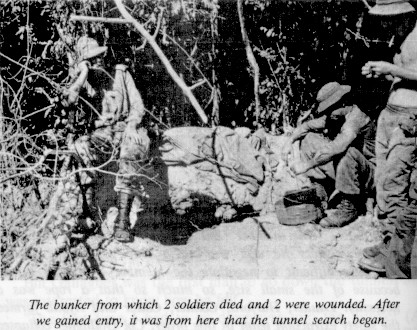
The next day I was called up to look at
the mound of earth from which the two medics had been shot. This was definitely
a job for engineers. We gained entry by blowing open a hole and, sure enough,
found spent cartridges, presumably from the bullets our four lads had copped.
But we also discovered a tunnel leading away from the position, and
disappearing far under the ground. Obviously, that was how the snipers had got
into their position. But how had they got into the tunnel? The standard
practise when any tunnels were discovered was to blow smoke down them then
looks for the telltale signs of other entrances. Once the entrances were
secured, tear gas was blown down to flush out any enemy troops and then the
tunnel entrances were destroyed with explosives.
Two months earlier,
in my initial report, I had highlighted how inadequate this was and had
suggested a radical new approach to tunnel warfare as it would
become known. I suggested then that, after smoking the tunnels out and pumping
tear gas down them, rather than seal them up, we should blow fresh air down
them, and send men wearing gas masks down to investigate. After the tunnel had
been cleared it could then be destroyed. We had developed a tunnel search kit,
complete with miners lamp style lights for our hats, just for such an
occasion. This would be our first chance to put it to proper use.
We
blew smoke into the tunnel and I divided the men into smaller sub units of twos
and threes and sent them off to investigate. It was my radio operator who found
the first entrance, which was booby-trapped. Wed already had a lot of
experience with VC booby traps, and he spotted that there were lines running
from the entrance to hand grenades in nearby trees. The idea was that if anyone
opened the entrance, the lines would pull the pins of the grenades and ka-boom!
Just to make sure the entrance wasnt booby-trapped on the inside too, I
sent a team of two men underground from the mound to check it out. It was
clear, and thats when the tunnel entrance could be opened and the
search could begin in earnest.
Prior to this, the tunnels we had
investigated had only been rat runs from underneath houses out to safety of
nearby paddy fields. But these entrances in the middle of the Ho Bo Woods were
signs of something bigger and more complex, which was confirmed when an
infantryman found another part of the tunnel system by accident while he was
digging a latrine several hundred yards away. We discovered that the first
tunnel ran right around the original landing zone to another mound with its gun
overlooking the clearing. It was obvious then that if 1RAR had landed there as
planned, wed have been the meat in a hot metal sandwich.
Once
wed blown smoke, then tear gas, then fresh air down the tunnels, I sent
a couple of men down to investigate. The entrance was so narrow it was hard to
imagine it was intended for people at all. There was a straight drop then it
doubled back up, like the U-bend under a sink. The tunnel turned again to go
along under the surface and became a little wider, but there still
wasnt room enough to turn around. It was terrifying down there, armed
only with a bayonet to probe for booby traps and a pistol to defend yourself.
Once youd negotiated the tight entrance and the U-bend, you
had to crawl along tiny passages, rubbing your shoulders on each side of the
tunnel, on all fours, with no way of turning round if you got into trouble.
Often youd find larger rooms, sections of tunnel that
were big enough to crouch or kneel in, but you werent to know that when
you first set out. The further the men went, the more complex the tunnel system
was revealed to be. There were drops, twists and turns, corners around which
the whole North Vietnamese Army could be waiting, for all they knew. The men
burrowed away, ever further, ever deeper, until they discovered a hidden danger
in the operation. Some of them began passing out in the tunnels due to lack of
air. But, despite the fact that there was no room to turn they were all dragged
back to the surface, usually after wed blasted more fresh air down to
them.
I had been sending the men down in twos, but even then, on at
least one occasion, both of them had to be rescued when they ran out of air. So
I organized some teams of three and even four, with the tail-enders paying out
telephone wire as their mates negotiated the twists and turns of the tunnel.
The man in front would check for booby traps as they went along, the second man
would support him and stay in touch with the surface by phone. The guys at the
back would sit at the tighter corners, making sure the cable didnt
snag. All the time theyd be taking to me or their section commander on
the surface, whod be using their reports to try to work out at ground
level where they were so that they could be dug out from above if necessary. We
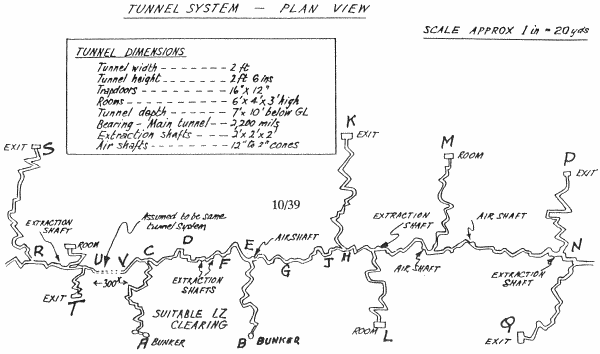
also tried to draw maps of the tunnel system as they described it.
During the operation, one Tunnel Rat, Corporal Bob Bowtell lost his life
investigating the tunnel systems. Lest We Forget.
The Underground
City. What we did and what we learned on Operation Crimp was incredible. 3
Field Troop came close to changing the course of the Vietnam War that week in
January 1966. If we had, it might well have changed history.
We had
gone to find and destroy the Saigon/Cholon/Gia Dinh political and military
headquarters of the Viet Cong. By the time we left we knew wed found it
and were pretty sure wed destroyed it. History shows that the former
assumption was correct while the latter was well off the mark.
We
were in the Ho Bo Woods for six days on Crimp, but every day dawned to
startling revelations, each of which was followed by even more amazing
discoveries.
We had three tasks. The first was to investigate the
tunnels as fully as possible to discover what they were being used for. The
second was to try and map the tunnel system so that we could work out its
extent, and if need be, dig down to a soldier who might be trapped. The third,
once we discovered what a treasure trove the tunnels were, was to recover
everything we could weapons, equipment and paper all of which
was invaluable for the intelligence boys.
But with the constant
danger of men either collapsing in sections with foul air or coming face to
face with the enemy, mapping the tunnels was a priority.
We were down
in a tunnel and wed gone as far as we could have gone. But there were
branches off everywhere and we were told to just keep talking, tell us every
move you make. Every time you come to a corner go to the right, just go to the
right and we had to bring back compass bearings. I came to one turn and I just
couldnt go on but I thought Ill just go a bit further, and I
kept on going.
Then I came across a lot of gear stacked in the
tunnel. I was scrambling over the top of it. We got all this gear out, and from
there on we got more and more gear.
Day-by-day account.
On the first day, the Demolition Team allotted to A Company 1RAR
searched and destroyed a tunnel that was 80 feet long and had a sleeping bay
for approximately five people. There was nothing particularly unusual in that.
About twenty domestic trench, bunker and tunnel systems were
searched and destroyed. We also came across some homemade bombs and grenades
set as booby traps.
On day 2 the B Company Demolition Team
searched a bunker system under a house and found a room about 15 feet long by 7
feet wide by 5 feet high, full of weapons, ammunition, mortar shells, grenades,
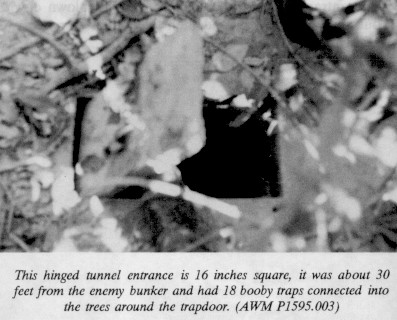
clothing and documents. The trapdoor entrance was only 16 inches square and was
hidden under a layer of dirt. We also had to deal with more booby traps,
including vicious barbed steel spikes in the ground, one of which went through
the foot of a soldier. The D Company Team searched bunkers and tunnels starting
from houses and finishing in open exits in the field, one was 45 yards long.
On day 3 we investigated a lot more tunnel systems, but only
one of the initial searches turned up anything of interest. We werent
complaining, it was quite a find. Again, the tunnel began under a house, but
this time instead of weapons, we found a typewriter, medical supplies and
documents.
The C Company Demolition Team blew smoke and tear gas
through after that then, when no one came out, blew up the tunnel entrances to
seal it.
The A Company Team found a homemade rifle, a sewing machine
and a radio in a tunnel under a house. One Viet Cong was hit by gunfire and
disappeared down a hole in the group. The hole was tear-gassed then a grenade
was dropped down it. The assumption then was that the enemy would have died.
Now Im not so sure. He could have been miles away for all we knew. We
found sewing machines and the rolls of material, weapons and a makeshift
hospital, living quarters and a cooking area. You cant put the
magnitude of it into words. You just think of a tunnel as a tunnel, no rooms or
anything like that running off it.
The D Company Team found a
wireless and an ID card in another tunnel and a whole squad of Viet Cong was
seen disappearing in the same area. When the tunnel system was found this cache
of 12.7mm Chicom Anti-aircraft guns, webbing, grenades, magazines, rice,
weapons, and heaps of paper work were retrieved. This was our first really big
weapons cache.
Day 4, saw us find several trapdoors and
tunnels and once again we could hear Vietnamese voices down there. It was on
this day that Bob Bowtell died. He was the leader of the B Company Demolition
Team. I was astonished to find in my records that the tunnel entrance he
squeezed himself into was only 16 inches by 11 inches. On the same day, the C
Company Team used the dog team to confirm Viet Cong activity in the tunnel that
was later blown up. At night we could hear the sound of VC trying to dig
themselves out. We tried to dig down to them and the entrances were opened and
teargas was blown through, but nobody came out.
On Days 5 and
6 all the Company Demolition Teams were still finding amazing amounts of
arms, equipment and documents, especially from the larger rooms they had found.
And despite Bobs death, the men were still keen to go down the tunnels,
especially if there was a prize at the end of it.
By the time we got
ourselves properly organized, there were four teams of six, each attached to an
infantry company, and we had men underground in shifts from dawn until dusk.
Besides all the tunnel work going on within the companies
tactical area of responsibility, the major tunnel system was being searched all
week. We had investigated tunnels for 700 metres in one direction and 500
metres across that line and we still had no idea how far the tunnels extended.
We had taken out truckloads of equipment and documents, including photographs
of the Viet Congs foreign advisers and a hit list of political and
military figures in Saigon whom the VC wanted to assassinate.
The
next day whilst searching the tunnels within the battalion perimeter, we found
another trapdoor leading to a third level, before it could be investigated, the
Americans decided to wrap the operation up and pull out. We only went back down
the tunnels long enough to line them with explosives and bags of tear gas
crystals. Our intention was solely to destroy the tunnels as best we could and
leave those parts that we couldnt destroy as uninhabitable as possible.
We never found out what was beneath that trapdoor, at least, not until many
years later.
What we knew was that we had stumbled upon hospitals and
classrooms containing so much equipment that the Americans assumed we had found
the Viet Cong headquarters. Even if that had been true, it was still an
astonishing feat for the Viet Cong to have constructed the parts of the tunnel
system we had found. But it was just a tiny part of a larger system, which ran
for 200 miles.
We would only discover a couple of decades later that
beyond that final trapdoor was the military headquarters of the Southern
command of the Viet Cong. At the other end of our search, we were just as close
to discovering the VCs political HQ.