Stop Smoking
Today tobacco companies are beginning to admit the addictive qualities
of nicotine. Researchers differ on the potency of nicotine but
it has been found that between 33% and 50% of "experimental" smokers
become addicted. This can be compared with the 3% to 20% of people
who "experiment" with cocaine and become addicted. Further research
also shows that an adolescent who smokes as few as four cigarettes
has a 94% chance of continuing to use tobacco for a substantial
part of his or her life!
There are many reasons why a person may begin smoking: peer group pressure, defying authority, improving self
image (adolescents may think it's 'cool' or sophisticated to smoke).
The main reason for continued use
is the perceived benefit from nicotine as a relaxant to manage
stress. However, whilst the belief may be "every time I have a
cigarette, my hands and body stop shaking and I relax", the fact
is that the heart rate, and thus stress, actually increases. Unfortunately
you may think you feel better!
There are many "medication" based approaches to the treatment
of tobacco and nicotine addiction. Virtually all of them are successful
for some smokers. Sadly, others remain unable to quit no matter
what they try. There are two major reasons
for this:
- They don't have a compelling enough reason for quitting.
- They may not know how to change
a habit.
It is essential to have a reason to quit that is stronger than
the reason to continue. Some reasons are improved health, saving
money, social acceptance; unfortunately, some people need to be
shocked into stopping, like developing a life threatening illness,
or losing a loved one.
If you truly have the desire to stop smoking, but don't know how
to change, then the key lies in understanding
and using the power of the subconscious mind to change
the habit.
How Can The Subconscious Mind Change A Habit?
Your mind has two components each with separate functions. There
is the conscious mind, which is 12% of our mind, and the subconscious
mind, which is the other 88%.
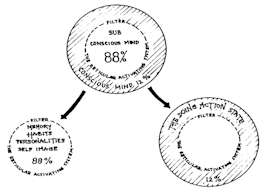 The
conscious mind is the one we readily identify with, it is our
"doing state" that we use to perceive the world and make decisions
with such as "I would like to stop smoking".
The
conscious mind is the one we readily identify with, it is our
"doing state" that we use to perceive the world and make decisions
with such as "I would like to stop smoking".
The subconscious mind is responsible for storing our memory, habits
("when I get upset I smoke a cigarette"), beliefs ("smoking relaxes
me") personality and self-image ("when I smoke I look sophisticated").
It also controls our bodily functions. Notice that you don't have
to consciously think about doing these things.
Although we can become aware of our subconscious compulsions towards
smoking, we often have difficulty in changing them. When we form
a conscious desire ("I want to stop smoking"), we come up against
our existing habit ("When I experience too much stress I have
a cigarette and a coffee!"). This is therefore 12% of your mind
battling with the other 88%. If you attempt to make this a battle
of conscious will, you normally experience stress as you fight
to discipline yourself to keep to your "non-smoking" plan, enduring
much pain and suffering. It is for this very reason that most
people will either deviate from their program within a week of
starting, or give up completely. The conflict between the conscious
and the subconscious mind is fought inside on an emotional level;
a conflict which you do not need to experience if you understand
how one can control the other.
Because the subconscious mind contains the habit of smoking, it
is essential to access this part of the mind. This can be done
through relaxation. Once you have
accessed the subconscious, it is then possible to change
the subconscious program or "thinking" that creates
the habit which compels you to smoke. By changing that habit and
practising other methods of managing stress, a person can free
themselves of a smoking habit forever!
These are the main steps:
- Finding a compelling reason to stop smoking.
- Understanding the subconscious beliefs which support continued
smoking.
- Learning the most effective way to communicate with the
subconscious mind, especially in the wording of your goals.
- Reprogramming these subconscious beliefs to support a new
habit of non-smoking.
- Learning and developing alternative methods for relaxation
and releasing stress.
Understanding The Subconscious Beliefs Which Support Continued
Smoking
Basically we are aroused by only two sensations, pain and pleasure.
We all want to avoid pain and pursue pleasure. The emotional cycle
which can lead to unwanted behaviour begins in the present with
our initial experience of pain, and ends with complex feelings
which are "remembered" exclusively in the past. This cycle of
emotions has been found by psychiatrists to follow this pattern:
- Pain in the present is experienced as hurt.
- Pain in the past is remembered as anger.
- Pain in the future is perceived as anxiety or fear.
- Unexpressed anger, redirected against yourself and held
within is experienced as guilt.
- The depletion of energy that occurs when anger is redirected
inward creates depression.
Hurt is stored because the body retains a primitive subconscious
ability to remember every incident that it experiences. This is
called conditioning and it is part of the way we learn.
These hurts become "conditioned subconscious reflexes" and are
subsequently modified by our behaviour. Let's consider some examples
of how this happens:
Two young children are in trouble for being involved in a misdemeanour.
As they await their punishment one child offers the other a cigarette
to help them relax. The other accepts because smoking is a further
act of defiance and a furthering of the social bond between the
two. The smoke may taste awful but emotional well being is formed
through acceptance of the offer. This then may encourage further
smoking. Cigarettes make the child feel better and a new association
between fear/stress and smoking as a comforter is formed.
New Conditioned Reflex
I become afraid à I desire a cigarette
because I know smoking will make me feel better.
A girl breaks up with her first boyfriend. She feels upset and
depressed. Well-meaning friends take her out dancing and when
the others light up, she joins them. The camaraderie and the cigarettes
make her feel better, and a new association between smoking and
overcoming emotional depression is formed.
New Conditioned Reflex
I become depressed à I desire a cigarette
because I know smoking makes me feel better.
Therefore a lot of smoking habits are misdirected reactions to
emotional stress.
Coincidentally this is also the mechanism behind overweight. This
is why many smokers who attempt to give up smoking gain weight,
as eating becomes the new "release" from emotional stress. The
opposite can also be true. Some smoking habits are formed, particularly
in young females, because a cigarette is "preferred" to eating
food as the method for releasing emotional stress.
Although understanding your relationship to this aspect of smoking
can take longer and requires greater insight and courage to accomplish,
it usually results in a lasting cure.
In the Life Skills Seminar we teach and practise the following skills:
- How to relax and release stress.
- A scientific explanation of how the brain works.
- How to access and work with the powerful subconscious mind.
- How to communicate effectively with the subconscious mind.
- How to make your language work for you instead of against
you - e.g.. you learn not to use the words "stop smoking"
and "non-smoker".
- Developing strong and compelling reasons to stop smoking.
- Understanding the subconscious beliefs which support continued
smoking.
- Reprogramming these subconscious beliefs to support non-smoking.
Finally the most important thing I would like to add is that to
achieve the goal of not smoking, you do not
have to believe that these techniques work. The subconscious mind
does not know the difference between reality and imagination -
so simply doing the mental exercises is enough! Many
seminar participants have achieved their goals in spite of their
scepticism - they felt they had nothing to lose, so they had a
go!
You May Ask "How Effective Are These Techniques?"
Here's a success letter from one of my seminar participants:
 I
had been a fairly heavy smoker (30 a day) for 27 years. I did
not make a big deal about the smoking as a goal, but it was there
in the background the whole time. On the Wednesday following the
seminar I had my last cigarette after dinner. Very cool, no fuss
- I just KNEW it was my last cigarette. A week later I still had
no urge to smoke - just a feeling of "what's missing?" I haven't
been irritable or cranky (haven't beaten the kids once!) and I
feel just great and not a little pleased with myself. I went on
and applied the techniques to releasing weight. I released 5 stone
(that's 31 kilos) - my self esteem soared, relationships improved
- you can just imagine all the great effects can't you? I feel
just great!
I
had been a fairly heavy smoker (30 a day) for 27 years. I did
not make a big deal about the smoking as a goal, but it was there
in the background the whole time. On the Wednesday following the
seminar I had my last cigarette after dinner. Very cool, no fuss
- I just KNEW it was my last cigarette. A week later I still had
no urge to smoke - just a feeling of "what's missing?" I haven't
been irritable or cranky (haven't beaten the kids once!) and I
feel just great and not a little pleased with myself. I went on
and applied the techniques to releasing weight. I released 5 stone
(that's 31 kilos) - my self esteem soared, relationships improved
- you can just imagine all the great effects can't you? I feel
just great!
Julie Van den Driesen, VIC
I was interested read that Dr Deepak Chopra also used this method
to overcoming his smoking habit. His explanation of how he did
this is extracted from his book Overcoming Addictions and is a good example of having a compelling reason to stop:
 I
began smoking when I was 17 years old. Over the years I made many
attempts to stop, but none were successful for long. I came to
despise my smoking habit, and I was angry at myself for indulging
in it. Very often I would furiously throw away the last five cigarettes
in a pack while promising myself to quit. But within an hour or
so I was furtively opening a new pack. I saw that in some way
the cycle of self-reproach and guilt was a mechanism that kept
my habit alive, but this insight had no practical effect on my
smoking. I simply acted out the sequence again and again. My intention
to quit was overwhelmed by the memories of smoking and the desires
they ignited.
I
began smoking when I was 17 years old. Over the years I made many
attempts to stop, but none were successful for long. I came to
despise my smoking habit, and I was angry at myself for indulging
in it. Very often I would furiously throw away the last five cigarettes
in a pack while promising myself to quit. But within an hour or
so I was furtively opening a new pack. I saw that in some way
the cycle of self-reproach and guilt was a mechanism that kept
my habit alive, but this insight had no practical effect on my
smoking. I simply acted out the sequence again and again. My intention
to quit was overwhelmed by the memories of smoking and the desires
they ignited.
Then one evening I went to the ballet. As I sat there in the darkness
admiring the graceful dancers, I could hear my own breathing coming
in wheezes and gasps. The contrast made a powerful impression
on me. Before me were superb athletes flying across the stage,
and here I was struggling just to breathe. The next day I was
about to open a new pack of cigarettes, I felt more than my usual
degree of guilt about my smoking. But I had learned by this time
that guilt was not enough to break my addiction: in some mysterious
way, guilt facilitated it. So instead of combining the toxic experience
of smoking with my own toxic self-reproach, I let my thoughts
return to the beautiful dancers I had seen the night before. By
doing so, I finally discovered the way to break the chain of my
addictive behaviour, and I threw away my package of cigarettes.
Over the new few weeks, I called upon the memory of the dancers
whenever I felt the desire to smoke. I gave up trying to fight
my addiction, and instead replaced it with a positive alternative.
Dr Deepak Chopra
Overcoming Addictions
So What is the Next Action Step that You Can Take?
CALM makes suggestions on how you can develop your skills in dealing with Stop Smoking using Sandy MacGregor's low cost Tapes, Books, CDs, Videos and Seminars which have been utilised by thousands of people successfully since 1990. [click here]