Using Your Subconscious Mind Deliberately
I first heard the term "subconscious mind" in 1982. Since that
time a lot has been written on this subject and many ideas and
theories put forward as to what is the subconscious mind and how
we can work with it. Although I have read widely on the subject,
I have chosen in my teachings to work only with scientifically
based and proven theories on how the subconscious mind works and
operates in our lives.
Why Is The Subconscious Mind Important?
The subconscious mind contains all our memory, our habits and
beliefs, personality and self image. Perhaps you want to change
a habit, such as smoking, or always reacting angrily when someone
'pushes your buttons". Maybe you wish to have better recall in
exams. Or you might be challenged by low self esteem. Whatever
you want to change, it is essential to change it in
the subconscious mind.
But were you taught how to do that when you were at school? Were
you born with a manual on how to operate your subconscious? Do
you know the laws and the language of the subconscious mind? In
my experience, most people answer 'No" to those questions!
What Is The Subconscious Mind?
When you buy a computer, you acquire the hardware which is the
computer screen, keyboard, disk drive and all the other bits and
pieces inside. However, when you plug the computer in, it will
not work without an "operating system". The operating system is
like a basic, predefined set of instructions which coordinates
the use of the hardware. Once the operating system is installed,
the computer comes to life and is able to perform fundamental
tasks such as saving information, but more importantly, it is
now able to accept further, more sophisticated programming. For
instance, if you want your computer to type letters. A word processing
(typing) program is required.
When you want to type a letter, you request the operating system
to start this program. What then appears on the screen is a blank
page, and as you type, the characters appear on the page. You
may not be aware of all the billions of electronic signals which
have been "programmed" by both the operating system and the word
processing program to flow through the computer in a particular
way so that you can type a letter. What you are consciously aware
of is the image on the screen.
The human mind/body system operates
in a very similar way.
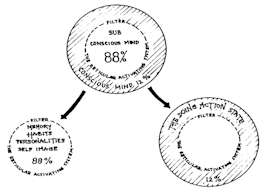 The conscious mind is our current
awareness. It can be likened to a word processor. As we type,
we make hundreds of decisions - what to write, whether we have
written the letter correctly, how the letter should look, etc.
The conscious mind is the decision maker. It requests the subconscious
programs to perform certain tasks ("let"s go to the shops"), observes
what the subconscious programs perform (moving the body to action),
and then decides on what else needs to be done.
The conscious mind is our current
awareness. It can be likened to a word processor. As we type,
we make hundreds of decisions - what to write, whether we have
written the letter correctly, how the letter should look, etc.
The conscious mind is the decision maker. It requests the subconscious
programs to perform certain tasks ("let"s go to the shops"), observes
what the subconscious programs perform (moving the body to action),
and then decides on what else needs to be done.
The sub-conscious mind is like the
operating system, and contains all our memory, habits and beliefs,
personality and self image. It also controls bodily functions.
The subconscious is both the storehouse of information (the closest
shops are in the shopping centre) and the performer of tasks (let"s
get this body moving by increasing the heart rate). It too contains
a set of "predefined instructions" about how many heartbeats to
complete, which way the blood will flow, what adjustments to make
if the body is walking, as well as what kind of reaction to perform
in specific situations (our habits). Note that you do not have
to consciously think about any of these things.
The body is like the computer hardware,
particularly the screen, set up to respond to the programming.
It is the framework within which all this activity takes place.
At any given time your body is responding to the programming that
is held within the subconscious mind - automatically.
The Role Of The Subconscious Mind
Your mind therefore has two components, each with separate functions.
The conscious mind is estimated to be only 12% of our mind, and
the subconscious is the other 88%.
 The subconscious
mind is important because it has the ability to record and remember
every incident that it experiences. This is called "conditioning".
It forms part of the way we learn and it enables us to perform
actions habitually (without thought). If you experience enthusiasm,
happiness or love when meeting a person, this mechanism will record
those feelings and associate them with that person.
The subconscious
mind is important because it has the ability to record and remember
every incident that it experiences. This is called "conditioning".
It forms part of the way we learn and it enables us to perform
actions habitually (without thought). If you experience enthusiasm,
happiness or love when meeting a person, this mechanism will record
those feelings and associate them with that person.
 Feelings of
frustration and stress are associated in the same way. When you
next see that person (or even just think about them!), the subconscious
mind automatically recalls the previous feelings, and they are
re-experienced. This is why thinking of happy memories can make
you feel good, and how the mere thought of a person can make you
feel angry.
Feelings of
frustration and stress are associated in the same way. When you
next see that person (or even just think about them!), the subconscious
mind automatically recalls the previous feelings, and they are
re-experienced. This is why thinking of happy memories can make
you feel good, and how the mere thought of a person can make you
feel angry.
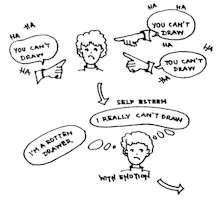
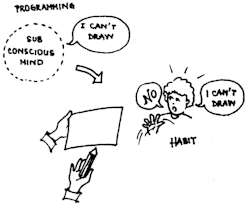
This mechanism is a system designed to protect us by emotionally
recalling the last experience (in Primary School everyone laughed
at me when I drew an elephant). This is in anticipation of a subsequent
similar situation (when I had to draw a seal in High School, I
immediately felt fear, told myself 'I can"t draw", and traced
the seal instead). However, it is also the reason we can continue
to experience a lot of other complex emotional conditions such
as depression, fear, anxiety, anger, procrastination, and lingering
grief, which can express themselves in other forms such as weight
gain, sleeplessness, smoking and general ill health. Recent major
scientific discoveries enable us to understand and control this
mechanism so we can change these conditions.
Your conscious mind can actually program the subconscious mind
for new behaviours and habits, in order to react more appropriately
to the different situations that we experience. This ability is
built into us. Nobody taught us how to walk or how to talk. These
miraculous feats of "self-education" were accomplished through
an intuitive process of observation, imitation and repetition
at a very early age. Unfortunately, as we grow older, many of
us get stuck in old behaviours that no longer serve us, and our
self-education ability appears to be forgotten.
One Mind To Overcome Many Different Challenges
On a day to day basis we face many challenges. Work pressure and
stress, challenging relationships, change, frustration with career
choice, questions of prosperity, difficulty in learning new things,
fear of accepting new experiences, grief or ill health - most
of these situations are viewed as problems.
Firstly, what are problems? Aren"t
"problems" really challenges which require you to learn, understand
and then apply something new? Hasn"t every problem you"ve encountered
in the past given you both new skills and valuable experience
so that you can deal with future "problems" more effectively and
efficiently? We only find problems difficult because we feel frustration
in wanting to accomplish something and we don"t know how. Yet
in many cases we need to come to this position because it is in
this moment we ask for help, and become open to learning a new
approach.
Secondly, from my experience, I
find that all these situations are ultimately asking us to do
just one thing - CHANGE! It is the process of change that we find
difficult and frustrating. Why do we find change difficult? Essentially
any decision to change is made in your conscious mind. This decision
will in some way conflict with your existing habits and beliefs,
and it is therefore the subconscious mind (the storehouse and
performer of tasks) which must be changed. This means 12% of your
mind wants to change the other 88%, and this is the source of
all the frustration that we experience.
What needs to be changed is the programming in the subconscious
mind so that the 88% is working with the conscious 12%. How do
we do that? The CALM Life Skills
Seminar teaches a simple, scientifically proven method in
which the conscious mind can influence the subconscious mind so
that they work together. This involves:
- Learning to access the subconscious mind easily and quickly.
- Understanding how the mind works with a complete scientific
explanation.
- Utilising the Laws and the Language of the subconscious
mind.
- Permanently imprinting goals into the subconscious.
- Proof - with biofeedback from an electroencephalograph.
You May Ask "How Effective Is What I Teach?"
How about I let some seminar participants explain that to
you:
 Dear Sandy,
Over the years I've been to all the seminars, and I've read all
the books, but none have ever truly delivered their promise.
Then in May of this year, I did your Life
Skills Seminar, and at last, I have scientifically
proven techniques that enable me to unleash the other 88% power
of my mind. And, for the first time, I've got easy to use tools,
to prove to myself, that what you claim actually works. (And now,
I also realise they'll produce fantastic results regardless of
a persons age. Children and teenagers at school, adults in the
workplace, adults retired... 6, 16 or 60 years, it doesn't matter...
these tools will literally work miracles for anyone.)
In the beginning, I admit I was very very sceptical. I really
didn't believe that your techniques would work. But then I discovered
I didn't have to believe in them, all I had to do was use them.
Because they work on 'automatic pilot.' And, unlike other seminars
that promise results in 30, 60 or 90 days, your techniques start
working on day one. For me, that truly was the clincher, and why
I decided to write and thank you.
All Australians, including Business Australia urgently needs to
Switch-On to your scientifically proven techniques. Once they
do, they'll raise prosperity for everyone, beyond their wildest
dreams.
I am now dedicated to promoting these life enriching skills of
yours wherever I can, because if they can work for me, they can
work for anyone.
Once again... Thank you!
Mike Cotter
MAYCOR Pry Ltd
PS Feel free to use this letter in any way you choose, and
if you come across more sceptics like me, just ask them to give
me a call any time on (03) 9787 8504. I'!1 be delighted to talk
with them.
So What is the Next Action Step that You Can Take?
CALM makes suggestions on how you can develop your skills in dealing with Using Your Subconscious Mind Deliberately using Sandy MacGregor's low cost Tapes, Books, CDs, Videos and Seminars which have been utilised by thousands of people successfully since 1990. [click here]