The Influence of The Subconscious Mind In Learning
How do you feel at the moment of learning something new? Are you
enthusiastic approaching a new task, confident that you will eventually
overcome any initial mistakes and errors as you develop your ability?
Or is your feeling about your ability to learn new things something
quite different? Recent, major scientific discoveries are shedding
new light on the influence of our subconscious mind on our ability
to learn. More importantly, these discoveries reveal how we can
successfully manage our subconscious.
The Role of The Subconscious Mind
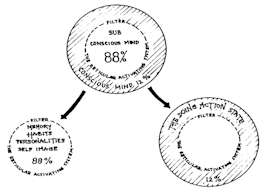 Your mind has two components each with separate functions. There
is the conscious mind, which is 12% of our mind, and the subconscious
mind, which is the other 88%. The conscious mind is the one we
readily identify with; it is our "doing state" that we use to
perceive the world and make decisions, such as "I need to study
chemistry tonight". The subconscious mind is responsible for storing
our memory, habits, beliefs ("I always have difficulty understanding
chemistry!"), personality, self-image. It also controls our bodily
functions (notice you don't have to consciously think about doing
these things).
Your mind has two components each with separate functions. There
is the conscious mind, which is 12% of our mind, and the subconscious
mind, which is the other 88%. The conscious mind is the one we
readily identify with; it is our "doing state" that we use to
perceive the world and make decisions, such as "I need to study
chemistry tonight". The subconscious mind is responsible for storing
our memory, habits, beliefs ("I always have difficulty understanding
chemistry!"), personality, self-image. It also controls our bodily
functions (notice you don't have to consciously think about doing
these things).
The subconscious mind is important because the body retains a
primitive mechanism which has the ability to record and remember
every incident that it experiences. This is called "conditioning".
It forms part of the way we learn and it enables us to perform
actions habitually (without thought). Therefore if you experience
enthusiasm and satisfaction while learning a new task, this mechanism
will record those feelings and associate them with that task.
Feelings of frustration and stress while learning are associated
in the same way. When you next do that task, the subconscious
association which was previously formed is automatically recalled,
and re-experienced emotionally. Previous feelings of happiness
and satisfaction are translated into enthusiasm, while feelings
of stress, frustration give rise to reluctance, doubt, fear or
anxiety.
Let's now consider an example which illustrates the above points.
Say for instance you think you are not a good learner and find
it hard to study for exams. Because you find study difficult you
are less likely to study and revise regularly throughout the year,
because it is not an enjoyable thing to do. By avoiding regular
revision you inevitably find yourself having to "cram" in the
final weeks for your exam. Cramming for a subject invariably creates
considerable stress, frustration and uncertainty about your true
ability to pass the exam.
The subconscious mind has recorded this entire experience of study
as a "remembered stress". This "remembered stress" can accumulate
and is experienced as a greater reluctance to study which constantly
needs to be overcome. This is why some students who consistently
place themselves under this kind of pressure find themselves unable
to "face their books" or study anymore. The very thought of study
subconsciously brings forward the associated
feeling of this "remembered stress" and anticipates
it being experienced again. This can then lead to an
inability to study effectively.
A person may have a conscious desire to perform a task, but will
experience an overriding subconscious fear or reluctance to do
it.
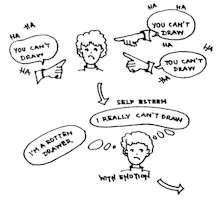 Although
we can become aware of our subconscious reluctance towards learning,
we often have difficulty in changing the feelings that we experience.
This is because our conscious desire ("I want to study") comes
up against our existing habit and belief ("I find learning chemistry
frustrating!"). Therefore 12% of your mind is battling with the
other 88%. If you make this a battle of conscious will, you experience
stress as you fight to discipline yourself to study, enduring
much pain and suffering. This is why most people procrastinate
over studying.
Although
we can become aware of our subconscious reluctance towards learning,
we often have difficulty in changing the feelings that we experience.
This is because our conscious desire ("I want to study") comes
up against our existing habit and belief ("I find learning chemistry
frustrating!"). Therefore 12% of your mind is battling with the
other 88%. If you make this a battle of conscious will, you experience
stress as you fight to discipline yourself to study, enduring
much pain and suffering. This is why most people procrastinate
over studying.
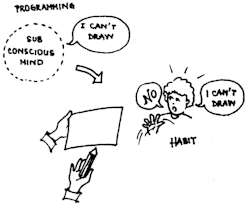 The
conflict between the conscious and the subconscious mind is fought
on an emotional level. It is a conflict which you can avoid if
you understand how one mind can control the other. The student
needs to learn:
The
conflict between the conscious and the subconscious mind is fought
on an emotional level. It is a conflict which you can avoid if
you understand how one mind can control the other. The student
needs to learn:
- A more effective method of study.
- A conscious ability to motivate oneself and rebuild motivation
as needed.
- A method of "neutralising" subconscious blocks.
- A method of reprogramming subconscious responses to learning.
In the Life Skills Seminar the ability to overcome subconscious blocks to effective learning
is taught by learning and practising:
- The ability to relax and release stress anytime, anywhere.
- The ability to focus your mind so that it does not become
distracted.
- Using the whole brain developing links and association for
improved learning.
- Using colour and mind charting for effective learning.
- Developing an awareness of self talk.
- Mind/body exercises to overcome subconscious blocks to learning.
- Mind/body exercises to develop greater self confidence in
your learning ability.
- The ability to program new responses to negative emotions
experienced while learning.
- Proof that you are able to perform these skills through
the use of bio-feedback equipment.
You May Ask "How Effective Are These Techniques?"
How about I let some of the seminar participants explain that
to you?
 In
1990 I was advised that doing my Higher School Certificate was
probably not in my best interest, as I should not, and really
could not expect to receive over 40 as a TER. The truth is, I
had nothing wrong with me, no crippling disease or brain disorder,
but more, that talent of being dyslexic, and this is where Sandy
helped me.
In
1990 I was advised that doing my Higher School Certificate was
probably not in my best interest, as I should not, and really
could not expect to receive over 40 as a TER. The truth is, I
had nothing wrong with me, no crippling disease or brain disorder,
but more, that talent of being dyslexic, and this is where Sandy
helped me.
After completing Sandy's CALM Seminar in 1991 I learned that being
dyslexic was a gift I had been given. There were of course the
frustrations of being 18 years old with a reading and spelling
capacity of an 11 year old. This, coupled with an extremely high
IQ, tremendous determination and dedication, made learning a challenging
experience. By applying techniques learned from Sandy I found
myself in the top 10 in all subjects. Not only was my school work
dramatically improving, but I also increased my interest in Stage
Management, where by the end of 1992 I had managed 10 professional
and school productions. My chronic asthma was controlled, not
through large doses of medication, but by intense meditation.
In 1992 I set myself targets and goals in regard to my Higher
School Certificate. I quickly learnt that setting goals is one
thing, but doing them is another.
CALM taught me to take control of my life and "Seize the day".
In January 1993 I received my Higher School Certificate results.
I had visualised the whole experience from the opening of the
envelope, my excitement, my parents expressions of delight. Sometimes
all the visualisations can not get you prepared for the actual
event.
The event was as I visualised, but far more. In all my subjects
I was in the top 10% of the state, as well as being placed 5th
in the state for Modern History.
I set my goals, I worked towards them and the best part is I out
did them. CALM has allowed me to turn a negative into a positive,
believe in myself, set goals and out do them, but most of all
I have learned "the sky is the limit".
Thanks Sandy and may all the success in the world come to you.
Georgina Bovill, NSW
 I have had many successes in my personal life since doing my first
CALM seminar with Sandy. I think the one that stands out the most
was my end of year exams. At age 45, going back to school to study
was a very big decision I had made. In my second semester we had
a teacher in Business Statistics who wasn't doing his job very
well and I knew I had to do something to help me get through.
I have had many successes in my personal life since doing my first
CALM seminar with Sandy. I think the one that stands out the most
was my end of year exams. At age 45, going back to school to study
was a very big decision I had made. In my second semester we had
a teacher in Business Statistics who wasn't doing his job very
well and I knew I had to do something to help me get through.
I had bought Sandy's tape Achieving in Exams and Effective Study.
So during the last month before my exams I would listen to the
tape and then study with Accelerated Learning Music. I also used
Mind Maps. When it came time for the exam I felt that I had done
my best but was not confident that I knew the work well. I also
got copies of past papers which I studied. When it came time to
take the exam I became really excited when during the 10 minutes
reading time I was able to recall my mind maps and the answers
just came flooding into my mind and the exam was so easy that
I knew I had been successful. I've received my results to that
exam and I got the A I visualised, in Business Statistics. I put
my success down to the positive attitude that I had after meditating
with my tapes.
Yvonne Potts, NSW
So What is the Next Action Step that You Can Take?
CALM makes suggestions on how you can develop your skills in dealing with The Influence of The Subconscious Mind In Learning using Sandy MacGregor's low cost Tapes, Books, CDs, Videos and Seminars which have been utilised by thousands of people successfully since 1990. [click here]