Overcoming Procrastination
What is procrastination? Basically it is the desire on one level
to do a task and then the refusal on another to actually do it!
When confronted with the idea of doing a job this internal conflict
can be experienced by a person as anything from "butterflies"
in the stomach, a desire not to "do it", to a complete physical
paralysis from being overwhelmed by fear! But how does procrastination
originate? It can quite easily be understood in terms of the function
and roles of the conscious and subconscious mind and an understanding
of "comfort zones" which are your current habits and ability to
do work.
The Influence Of The Conscious And Subconscious Mind
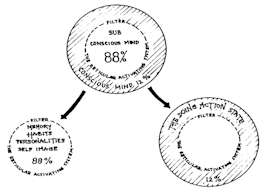 Your mind has two parts each with separate functions: there is
the conscious part, which is 12% of our mind, and the sub-conscious
part, which is the other 88%. The conscious part is the one we
readily identify with. It is our "doing action state". It is what
we use to perceive the world and to make decisions such as "I
want to do my tax return". The subconscious mind is responsible
for storing our memory ("the last time you did your tax return
you had to pay a large amount of tax!"), plus habits ("I can never
understand how to fill in that darned tax return!"), personality,
self-image. Also it controls our bodily functions (notice you
don't have to consciously think about doing these things).
Your mind has two parts each with separate functions: there is
the conscious part, which is 12% of our mind, and the sub-conscious
part, which is the other 88%. The conscious part is the one we
readily identify with. It is our "doing action state". It is what
we use to perceive the world and to make decisions such as "I
want to do my tax return". The subconscious mind is responsible
for storing our memory ("the last time you did your tax return
you had to pay a large amount of tax!"), plus habits ("I can never
understand how to fill in that darned tax return!"), personality,
self-image. Also it controls our bodily functions (notice you
don't have to consciously think about doing these things).
The subconscious mind retains a primitive mechanism, which records
the "experience" of every situation you encounter. This is called
"conditioning" If you either anticipate
(think about) or actually experience that same situation again,
those previous feelings will be re-experienced
emotionally in the form that it was originally recorded
which can be either a positive or negative emotion - for instance
fear ("I really hate doing tax returns!"), anxiety or love. This
mechanism forms part of the way we learn.
Comfort Zones
 People seldom procrastinate over doing jobs which they enjoy.
However people are known to procrastinate, or "put off" doing
tasks if there is a new component, a difficult task to perform,
or there is something else they would rather do. Procrastination
is therefore an uncertainty or fear associated with doing something
new, difficult or unpleasant, which can occur
even though you may have the confidence to do it! Firstly,
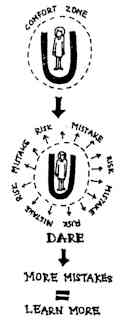
what is involved when we are learning something new? Your "comfort
zone" is your current ability to perform the current job. In being
able to perform any job you have also formed supporting habits.
People seldom procrastinate over doing jobs which they enjoy.
However people are known to procrastinate, or "put off" doing
tasks if there is a new component, a difficult task to perform,
or there is something else they would rather do. Procrastination
is therefore an uncertainty or fear associated with doing something
new, difficult or unpleasant, which can occur
even though you may have the confidence to do it! Firstly,
what is involved when we are learning something new? Your "comfort
zone" is your current ability to perform the current job. In being
able to perform any job you have also formed supporting habits.
When you expand your comfort zone there is always a need to understand
a new skill and practise performing it (to form the habit). Procrastination
arises through the subconscious activating a fear or reluctance
to go through this process of learning (this reluctance can appear
independently of your conscious desire to perform the task). Why
does this happen? It is simply the function of the subconscious
mind to alert us to past situations where we experienced stress
as part of learning. These stresses may have been a feeling of
vulnerability experienced while learning something new or feeling
embarrassed by the mistakes we have made and criticism we received
for making them. The actual reason as to why
this feeling of fear exists does not need to be understood (the past can just simply be let go). All that needs to happen
is that suitable mental exercises be performed which will erase
the feelings of reluctance and imprint the new conscious desires.
Let's now consider an example which illustrates the above points.
Say for instance you are not the best at learning and find study
for exams difficult. Because you find study difficult you are
less likely to study and revise regularly throughout the year
because it is not an enjoyable thing to do. By doing this you
inevitably find yourself having to "cram" in the final weeks for
your exam. Cramming for a subject invariably creates considerable
stress, frustration and uncertainty about your true ability to
pass the exam.
The subconscious meanwhile has recorded this entire stressful
experience in relation to your ability to study as a "remembered
stress". This "remembered stress" can accumulate and continues
to be experienced as a greater reluctance to study which needs
to be constantly overcome. This is why some students who consistently
place themselves under this kind of pressure finding themselves
unable to "face their books" or study anymore. The very thought
of study subconsciously brings forward the associated
feeling of this "remembered stress" and anticipates
it being experienced again. The feeling of this anticipated
stress can sometimes become so strong that the student no longer
wishes to study.
Accordingly a person may have a conscious desire to perform a
task but will still experience an overriding subconscious fear
or reluctance to do it.
Therefore several skills are required which are taught in the Life Skills Seminar
- An ability to neutralise remembered stress
- A deliberate approach to develop and rebuild motivation
towards a goal
You May Ask "How Effective Are These Techniques?"
Here is what one of my seminar participants had to say.
Dear Sandy,
I thought I would write to you again, thanking you for the
help you and your course has given me and secondly to update you
on overcoming what was for me a profound procrastination habit.
As I have mentioned to you earlier I had always been full of great
ideas and a belief that I could do the job, but always when embarking
on a new endeavour I would eventually become fainthearted, frustrated,
negative or just lose interest. There was always a good explanation
in my mind for why I was doing this but another part of me (my
conscious self?) could see an undeniable pattern emerging which
I could no longer ignore if I really wanted to get on with my
life and contribute in the way I knew I could.
So I spent hundreds of hours reading every kind of psychological,
philosophical, and self help book imaginable. Although these books
gave me wonderful ideas and a clear insight into this issue, they
were of course unhelpful in assisting me to actually overcome
the challenge. What I needed was the mental tools which enabled
me to focus my mind and a method for erasing the old subconscious
patterns. However I did not realise this until I actually attended
your seminar and applied what you said! Looking back it was a
close thing that I actually attended your seminar. I only attended
because a friend of mine keep insisting! I thought I knew everything
about the conscious/subconscious relationship (what I didn't know
was how to actually apply it!). I remember attending and still
not being convinced about what you claimed you could achieve,
but at the end of the two days you had told me of things I didn't
know and reminded me of things I had forgotten and inspired me
enough try. However in my heart I really didn't believe it would
work, because what you said conflicted with the modern psychological
approaches and after 8 years of trying different approaches -
I thought it would taking something dramatic to bring me out of
this rut (like a lightening strike!) not some silly two day seminar!
There was also a part of me that wanted to prove you wrong!
Well as you know the very next day, as I began to apply your techniques
I began to experience a miracle confrontation and then transformation
within myself which has changed my life forever.
Now a year and a bit since completing your seminar (twice) I can
look back on the most profound, remarkable personal journey which
has seen a large part of me completely transformed (there is always
more work you can do on yourself!). Gone are the old attitudes,
negativity, hang ups, excuses, self doubt, sadness, depression
and difficulties. One by one each one of these demons which have
dared to stand in the way of my dreams, goals and aspirations
have been hunted down and eliminated forever. Now my mind is truly
locked in and focused on accomplishing the task at hand and 14
to 18 hour days of work are now commonplace for me (maybe I should
come back and learn how to relax?). I now know behind the mind
of every procrastinator beats the heart of a workaholic and I
also now laugh at the solutions put forward by modern psychology
in this area as your work is easy to understand and unbelievably
simple to apply. I'm sure the reasons why other people may procrastinate
are something only they can understand (only after learning how
to inquire within themselves) but it has been for me a need to
overcome this area, a need to actually understand myself better,
to love myself and my work more, to develop a more disciplined
mind which is able to focus clearer and relax and release stress
(I can get a bit impatient with myself when I move at a million
miles an hour!) as I develop new habits and skills.
I wish you and every other seminar participant who is interested
in facing this concern every success.
Again thank you for all your help.
VJ Duckmanton, NSW
So What is the Next Action Step that You Can Take?
CALM makes suggestions on how you can develop your skills in dealing with Overcoming Procrastination using Sandy MacGregor's low cost Tapes, Books, CDs, Videos and Seminars which have been utilised by thousands of people successfully since 1990. [click here]